
the Helpful Hunters
the Helpful Hunters
the Helpful Hunters
Spiders eat large quantities of insect pests both inside your home and in your garden. Tolerating them and their webs reduces the need for pesticides.
There are more than 3,000 species of spiders in the U.S., but few are dangerous or even have mouthparts strong enough to pierce human skin. In California, the few venomous spiders that affect humans are not aggressive and will seldom bite humans.
If you’re not comfortable having a few spiders indoors to assist with pest management, it’s better to move them outside rather than kill them. If needed, use physical methods to kill them (such as vacuuming or crushing them) rather than pesticides.
Catch the spiders in a container, cover with a piece of paper, and release outside.
Remove webs by vacuuming with a crevice tool.
Observe what those spiders are eating. Reduce their food supply by controlling flies and other insects in the home.
Keep spiders out of the house. Caulk cracks and crevices. Install door sweeps under doors and screens on windows.
Don’t spray your garden or around the outside of your house to kill spiders. Sprays will not affect spiders unless there’s direct contact. Outdoors, spiders provide a very useful pest control service. Leave them to do their job!
Use a cobweb brush to remove spiders and webs from the side of your house and under eaves. You’ll find these brushes at hardware stores and garden centers. Look for brushes that have telescoping handles and soft, microfiber bristles.
Replace the white lightbulbs outside of your home with yellow bulbs. Yellow light attracts fewer insects, which in turn will attract fewer spiders.
These common spiders hunt down garden pests.
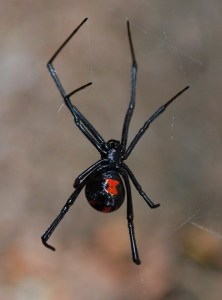
Black widow spiders hide during the day and come out at dusk to wait in their webs for prey. The black widow found in California is the shiny native, Latrodectus hesperus. The female sports a red hourglass-shaped mark on the underside of her abdomen.
Black widow bites are painless or may feel like a pinprick. They can cause flu-like symptoms for a few days, or in some cases, painful muscle spasms. If you think you’ve been bitten, ice the bite and call the California Poison Control System at 800-222-1222. If your symptoms are severe, go to the emergency room where you can get an injection of an anti-venom serum.
If you can, capture the spider. Drop it into a small jar of rubbing alcohol and take it with you for identification.
Near the ground, in protected crevices in and around buildings, such as lower portions of seldom-used cupboards, closets, or other dark, dry storage areas.
In woodpiles, lumber piles, or rock piles.
Inside the hollow parts of outdoor furniture or stair railing.
In water meter boxes and irrigation control boxes.
Wear gloves to clean up garages, debris, or woodpiles outside, and undisturbed storage areas and piles of clutter inside.
The brown widow spider, Latrodectus geometricus, lives in Southern California and is a mottled brownish yellow. Its bite is much less toxic to humans than the black widow’s and rarely needs any medical attention. The good news is that in some areas, the brown widow is running the black widow out of town.
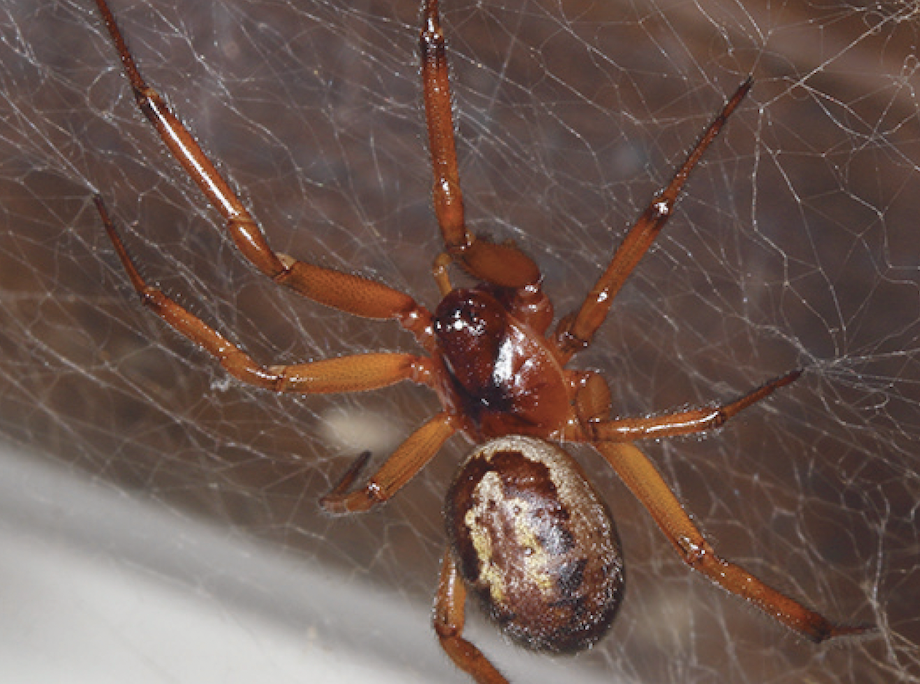
The false black widow, Steatoda grossa, is smaller than the true widow and the females do not have red coloration on their belly. They’re more likely to live indoors, but their bites are relatively mild.
For more information about black widows, brown widows, and false black widows, go to https://cisr. ucr.edu/invasive-species/how-identify-brown-widow-spiders.

Black widow spiders hide during the day and come out at dusk to wait in their webs for prey. The black widow found in California is the shiny native, Latrodectus hesperus. The female sports a red hourglass-shaped mark on the underside of her abdomen.
Black widow bites are painless or may feel like a pinprick. They can cause flu-like symptoms for a few days, or in some cases, painful muscle spasms. If you think you’ve been bitten, ice the bite and call the California Poison Control
System at 800-222-1222. If your symptoms are severe, go to the emergency room where you can get an injection of an anti-venom serum.
If you can, capture the spider. Drop it into a small jar of rubbing alcohol and take it with you for identification.
Near the ground, in protected crevices in and around buildings, such as lower portions of seldom-used cupboards, closets, or other dark, dry storage areas.
In woodpiles, lumber piles, or rock piles.
Inside the hollow parts of outdoor furniture or stair railing.
In water meter boxes and irrigation control boxes.
Wear gloves to clean up garages, debris, or woodpiles outside, and undisturbed storage areas and piles of clutter inside.
The brown widow spider, Latrodectus geometricus, lives in Southern California and is a mottled brownish yellow. Its bite is much less toxic to humans than the black widow’s and rarely needs any medical attention. The good news is that in some areas, the brown widow is running the black widow out of town.
The false black widow, Steatoda grossa, is smaller than the true widow and the females do not have red coloration on their belly. They’re more likely to live indoors, but their bites are relatively mild.
For more information about black widows, brown widows, and false black widows, go to https://cisr. ucr.edu/invasive-species/how-identify-brown-widow-spiders.